The backhoe had dug a construction trench about six feet deep, as Bart Humble remembers it, when the machine turned over a rock and the operator spotted a strange-looking cylinder. The cylinder leaked black goo.
The workman recognized the device immediately. It was an unexploded stick of dynamite.
“He said he high-jumped out of the trench,” Humble recalled.
The explosive apparently had been left behind during earlier construction work. It remained, buried and unexploded, beneath a Lindberg Avenue parking lot for 40 years.
Now that it had resurfaced, Humble’s job was to get rid of it. He headed MARTA’s bomb squad at the time. Humble and his crew had a bomb-exploding robot, but the construction trench was too narrow for the machine, so they had to figure out a different way to dispose of the explosive.
They decided they first had to contain any explosion. They headed to a lumber yard and bought a bunch of 6-by-6-inch beams. They built a roof over the trench and covered it with sandbags. “My other two bomb techs and myself had to build all this,” he said.
Then they put an explosive on a long pole and stuck the pole into the trench. They set off their explosive and immediately “there was a secondary explosion.”
No more dynamite. Problem solved.
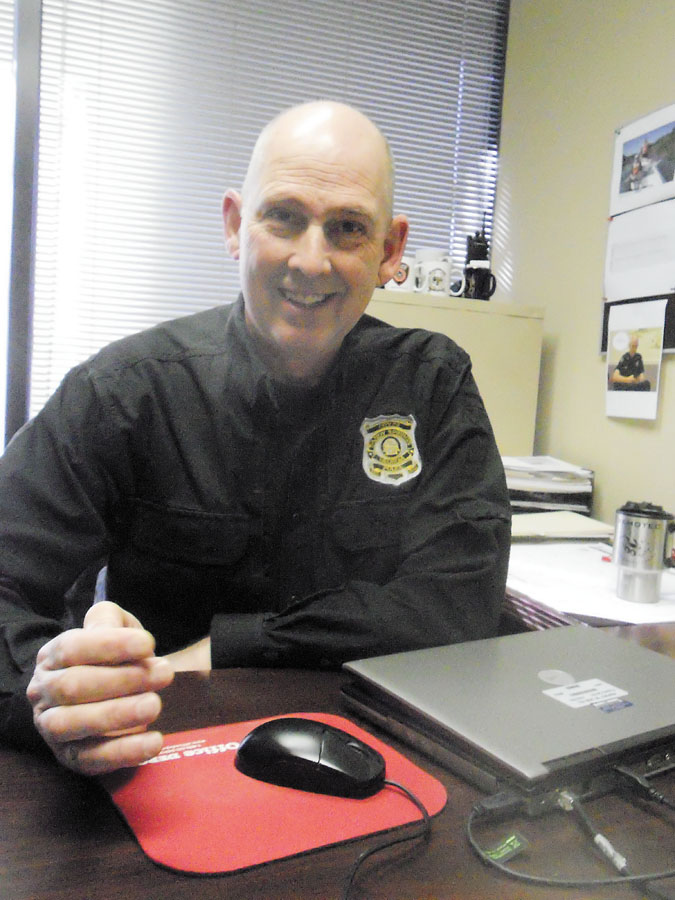
Humble, now a lieutenant with the Sandy Springs Police Department, doesn’t blow up stray explosives any more. Instead, as head of Homeland Security for the SSPD, he deals with potentially explosive situations.
The 61-year-old veteran police officer spends his time planning how the department should deal with all sorts of emergencies — floods, tornadoes, terrorists, riots. He also advises local companies on their plans for dealing with emergencies.
“It’s as much emergency management as it is Homeland Security,” he said. “When Homeland Security came up after 9/11, local agencies starting bringing up their own [departments]. … Our focus in Sandy Springs is not just terrorism, it’s preparation for all hazard emergencies.”
Still, there’s a little terrorism in there, too. He says he does monitor public statements by outside groups that might bring trouble to Sandy Springs – he keeps an eye on Occupy Atlanta’s web page, for instance, and he says he monitored the notorious Westboro Baptist Church of Topeka, Kan., when members came to town to picket. Still, most of his work now is planning.
In fact, one of his first jobs in Sandy Springs was dealing with the 2009 flood. He helped move horses from the Huntcliff subdivision’s flooded stables. He was used to working with horses, he said, because he grew up riding. A self-described “Army brat,” he says he grew up on bases scattered from Oklahoma to Japan.
Although he mostly plans now, he hasn’t forgotten the adrenaline rush of his bomb squad days. There’s a picture of a kind of bomb disposal robot on a coffee cup in his office. “That’s the robot we had [at MARTA],” he said.
And he can recount in detail the first time he confronted an explosive on the job. He was a DeKalb County patrol officer then, he said, and was called to an old pharmacy where someone cleaning the basement had come across a forgotten bottle of nitroglycerine. Some of the nitro had evaporated, concentrating the explosive. The department’s bomb expert asked him to help carry a little box containing the nitro out of the building so it could be dealt with.
“This [job] is probably more challenging. It’s more difficult,” Humble said, sitting at his desk in Police Headquarters one recent morning. “The bomb squad is more enjoyable.”
Enjoyable?
“In the bomb squad, you get to drive fast and blow things up.”
Want to share stories of some of the interesting people or places in your community? Email Joe Earle at joeearle@reporternewspapers.net.