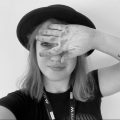
“Dark Water/Bright Fire,” a solo exhibition of works by Aaron Artrip, will open at South River Art Studio on Friday, Aug. 11. The series of prints on display feature geometric images generated by an unlikely source: a synthesizer.
“It was the visuals of it, I became entranced with the visuals that it created,” explained Artrip as we sat together in the living room of his East Point home where he makes his art.
“Music is my first love, it’s the thing that I truly fell in love with first. And I think I’ve just been exploring that rough art this whole time. Not music as a skill, but music as a sensorial experience.”

He clicked on his CRT TV, adjusted some dials on his synthesizer, and began moving cables around. A hum emanated from the speakers that changed with every adjustment. Some pitches were sharp and almost impossibly high – uncomfortably so – while other deeper tones felt meditative and rich. As the sounds changed so did the spiraling image on the screen. With the flick of a switch, a green laser danced across the far wall.
This is Artrip in his element. The table of instruments and gear in front of him are his toy box, while his growing portfolio of cyanotype prints are stored nearby.
Cyanotype is an ancient photographic printmaking process. First announced in 1842 and still popular to this day, the process involves coating paper with a chemical mixture that is sensitive to UV light. Objects can then be placed atop the dried coated paper and left in the sun to develop. Once washed in water, the outline of any objects blocking the sun remains. Artrip uses cyanotype to generate 2D art from his powerful laser.
Originally from Marietta, Artrip started playing music when he was about 11 years old. His father is also a musician and songwriter, so a love for music was a constant in his family home. Throughout high school he was still interested in art but the classes he wanted to take were booked, resulting in Artrip signing up for a drafting and engineering course instead.
After graduation he went on to Southern Poly State to pursue engineering, but he soon realized that he wasn’t truly driven to a career in the field. As the first in his family to attend college he felt it was important to go back to school. He enrolled at Kennesaw State University where he studied printmaking.
Later, Artrip enrolled in the Masters program at Georgia State University where he studied Studio Art with a focus in printmaking, drawing, and painting. He deepened his love for the printmaking process and developed some more ethereal ideas in his work.
It was during his time at GSU that he met and connected with painting and drawing Professor Craig Dongoski, who was also a printmaker and similarly interested in music. “He and I became buddies really quickly, and he helped sharpen the pencil of my artistic interests.”
Artrip’s thesis project, Many Instances of the Past, was the result of visualizing audio through a printmaking process. He began to use his artistic license and grew his art practice through play and experimentation.
“It was sort of giving myself permission to bring in all of my electronic toys from my home into the studio. Items like speakers, soldering iron, televisions, VCRs, monitors… I just started tinkering and playing around with them until I came up with something. I was really kind of going back to play.”


His interest in art alongside STEAM principles also landed him a position working as a Research Associate at Georgia Institute of Technology in a non-profit education research program. There he works with CEISMC, the Center for Education Integrating Science, Mathematics, and Computing. In his role he has created and managed the GoSTEAM website, led artist demonstrations, and liaised between K-12 students, artists, and related programs at Georgia Tech.
Now, it’s worth noting that the visualization of audio through experimental artwork isn’t new. One such notable example is American film producer Mary Ellen Bute who was one of the first female experimental filmmakers. In the early 1900s, Bute began experimenting and created a series of short films that explore the relationship of sound and image.
“I haven’t come across anyone who is solely making cyanotypes through sound as an image generation. It wasn’t my goal to be this person who is doing a hyperspecific approach to photography, that’s just where I landed.” For Artrip, the visuals and their prints have come to represent something a little deeper. He’s starting to draw a connection between these undulating waves and the feeling of emotional trauma in his body.
“It’s the amorphous experience of emotional trauma in the body,” said Artrip as he showed me some of his prints laid out on the tabletop. “Because, like emotional trauma, these images have an amorphous shape to them. They are two dimensional but they seem to have a third dimension. But they are intangible and they don’t actually exist.”


He also appreciates the way that his creation goes from spiky and sharp on his screen to a result that feels loose and soft in the cyanotype prints. Process has always been paramount for Artrip.
I asked if he ever ran pieces of music through the machine to see what effect they would have, and he explained that the complexity of songs generally creates what he describes as a “ball of yarn” when run through his system. Instead, he prefers individual sounds.
“Music is all the frequencies at the same time, played in a rhythm that’s pleasing to the ear. The sound and audio that I’m using to make these images are often not pleasant. Often they are chaotic and non-harmonic,” Artrip explained.
“There’s this interesting balance between the aggressive non-harmonic, harsh audio source and the output resulting image are often soft and delicate and otherworldly. There’s this translation between the input and the output.”


During the exhibition opening Artrip will generate experimental sounds and offer a little insight into his process for visitors as they peruse the prints on the walls. “Part of my performance on Friday will be inviting people into the world of what it’s like to sit and experiment with these sounds and have emotional reactions to them. Sometimes they are pleasant, sometimes they are harsh, and everything in between.”
Dark Water/Bright Fire will open at South River Art Studio with a reception on Friday night, Aug. 11 from 7 to 10 p.m. An artist talk will follow on Sunday, Sept. 3 from 12 to 2 p.m.