


Opening Jan. 23 at Whitespace Gallery, “Boundary Layers” is a group exhibition organized by Atlanta-based artist, educator, and independent curator Heather Bird Harris that brings together artists exploring how life emerges, adapts, and reorganizes at the margins. On view through March 7, the exhibition features work by 15 artists, including: Elizabeth M. Webb, Carlie Trosclair, Zipporah Camille Thompson, Renee Royale, Sachi Rome, Carley Rickles, Erin Palovick, Melissa McGill, Mary Mattingly, Michelle Laxalt, Madeleine Kelly, Alexa Kumiko Hatanaka, Elisa Dore, Hannah Chalew, and Kate Burke.
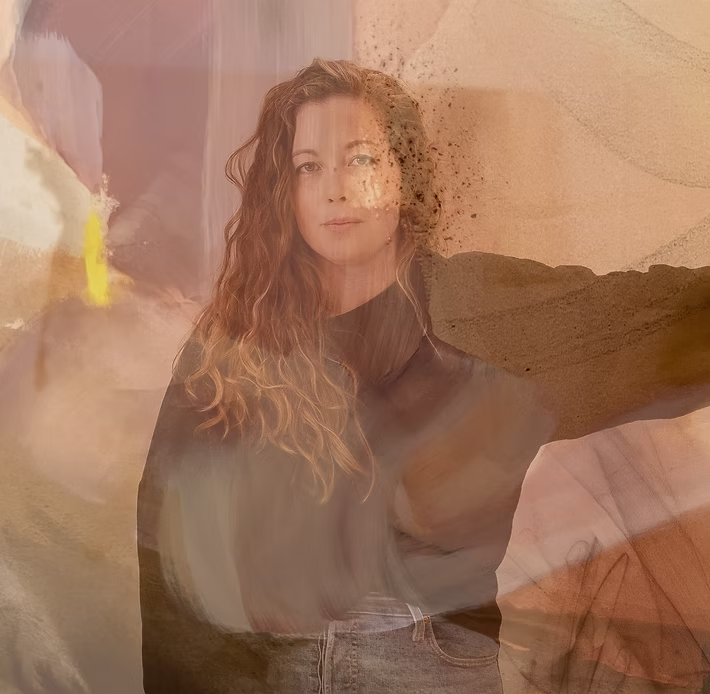
“This idea of how life moves and converges is something I explore in my own work, and I wanted to learn what other artists are discovering through their own material expertise and perspectives.”
—’Boundary Layers’ Curator Heather Bird Harris
Borrowing its title from ecology and fluid dynamics, “Boundary Layers” positions zones where systems meet—wetlands, waves, lungs—as sites of possibility. The exhibition unfolds across Whitespace, Whitespec, Peepspace, and two outdoor installations, intentionally uncontained in form. Rooted in Harris’s interdisciplinary practice bridging ecological art, pedagogy, and social systems, “Boundary Layers” lingers in conditions of transition, asking what life makes possible there.
In conversation with Rough Draft, Harris reflected on confusion as a starting point, learning from ecological systems under stress, and curation as a practice grounded in care, collaboration, and close attention.
“Boundary Layers” is grounded in the idea that life emerges in margins and thresholds. What drew you to that as a curatorial starting point?
Confusion, honestly. I’m confused about the speed of change we’re living through, and by how little language we have for staying with it. Something that’s helped me navigate the many unknowns right now is the idea of biomimicry—that any human problem can find its solutions by learning from life’s genius.
The question that’s been guiding my practice is: “How can we survive this?” What does life do when it’s experiencing stressful conditions and rapid change?
One place this happens naturally, all the time, is in boundary layers—the thin zones between physical states of matter where there’s intense behavior change and fluidity. They’re unstable, but they’re also generative. They help us breathe air into bodies made of water, enable birds to fly, and form tributaries. This idea of how life moves and converges is something I explore in my own work, and I wanted to learn what other artists are discovering through their own material expertise and perspectives.
You work across ecology, pedagogy, and social systems in your own practice. How did those ways of thinking shape your approach to curating “Boundary Layers”?
Well, I think many artists tend to work in this intentionally uncontained way, which is especially true for the artists in “Boundary Layers”. Western academic structures often isolate knowledge into disciplines, but a superpower of artists is the ability to see connections and collapse artificial separation to reveal relationships.
All of the artists in this show maintain expansive practices that include intense research, public practice, teaching, and many write and curate as well. For me, these actions function together as a rhizomatic methodology for learning, a way to get at the heart of something Ruth Asawa talked about this in her own practice as “completing the circle.” There’s input and output and exchange, and that’s necessary for cooperation and progress, ultimately. In other words, it’s all connected, and the more perspectives this knowledge-gathering includes, the closer it becomes to a form of truth.
And I’ll just add that it has to matter. There’s a lot of energy that goes into an exhibition, so if we’re going to exert any reserves of energy right now, it’s important that the work meets the moment in a meaningful way and offers something that doesn’t exist yet—an alternative way of looking at the moment we’re in.
The exhibition brings together artists working with material, process, and place in very different ways. What connections or shared questions guided your selections?
These are all artists who touch grass more often than most. They tend to walk very slowly, pay attention, and learn through intimate relationships to the natural materials they’re using and the places they’re working and living in.
There is a wide range of experimental approaches in the exhibition that are connected through shared concerns of material memory and the entanglement of human and more-than-human life. Each work in the show offers insights into how life moves and adapts through changing conditions.
The language of “Boundary Layers” references “wetlands, waves, lungs”—systems defined by permeability and exchange. How did you think about translating those ideas into the experience inside the gallery?
Well, it’s not just inside the gallery. The exhibition meanders between Whitespace, Whitespec, Peepspace, and two outdoor installations, so it’s uncontained by design. Each space offers a different investigation into the idea of boundary layer, from the vantage point of different points of the life cycle, how matter transforms through water and fire, and also the human folly of ignoring permeability and where that idea of human superiority has gotten us.
Reorientation is prioritized, and close looking. Come visit when you have time to look closely and wonder.
Read More:
• Spalding Nix Fine Art hosts ‘Ensemble 2025’ holiday group show
• Atlanta art moments to watch in 2026
Many of the featured artists work with living, ephemeral, or process-driven materials. What challenges or opportunities did that present in shaping the exhibition?
It necessitates more care, but that’s a good exercise. Many of the works change, respond, and sometimes resist containment, which feels appropriate to the conditions the exhibition is engaging. Some works will appear to die and grow again. The making of and caring for the work demands attention, not control.
In terms of opportunities, I think this show is the opposite of what AI offers us, which seems to be what so many are craving right now as a reaction to artifice—physical authenticity, real relationship, flaws, rawness, humanity. The material density insists on physical presence and relationship. That feels meaningful right now.
As a curator, how do you balance creating a strong conceptual idea while allowing each artist’s work to retain its own voice?
I think a good curator is similar to a good teacher. Both roles are about creating the conditions for individual and collective growth through care. This requires a clear vision and the ability to differentiate and respond, while offering challenging prompts alongside abundant support.
Ideally, curators and teachers create space that holds and guides the direction of learning while leaving plenty of wiggle room to play, connect, and be surprised by new connections. This balance relies on mutual trust, and when it works, the work or the learning doesn’t just coexist—it connects and builds across itself.
What do you hope viewers leave “Boundary Layers” thinking or feeling differently about?
I hope people payleave paying closer attention to the natural systems we’re part of and to the kinds of knowledge that don’t announce themselves loudly. I hope they sense that there are ways of navigating uncertainty that aren’t about mastery or control, but about relation.
I’ve been thinking about a metaphor adrienne maree brown shared recently, describing our current crisis as a kind of birth, in which we, as a species, are the baby—disorienting, uncontrollable, painful even, but moving toward life. Labor, physically and perhaps societally, requires boundary layers. It’s how new life begins.
“Boundary Layers” stays with those conditions of passage. It doesn’t try to resolve them. It invites us to notice what life does there and to consider how we might move, together, through what comes next.
“Boundary Layers” is on view at Whitespace Gallery Jan. 23–March 7.