

Take the elevator to the Lower Level of the High Museum of Art’s Wieland Pavilion, turn right, and you’re at the entrance of the Works on Paper Gallery, home, through next February, to the High Museum’s new “Paper Trees” exhibit, on view since July 31.

“Paper Trees” opens on a simple premise, one the 19th-century drawing instructor James Duffield Harding put plainly in his 1850 manual “Lessons on Trees”: Trees are among the hardest things to draw. A trunk is not a branch. A branch is not a twig. A bud reads differently than a leaf. Learning to draw a single believable tree, Harding argued, is its own kind of artistic education.
The why behind the works
That idea is central to the why behind “Paper Trees,” curated by Anni Pullagura, the High’s Margaret and Terry Stent Associate Curator of American Art. Walking visitors through the Works on Paper Gallery recently, Pullagura used the word “compulsion” to describe what draws her to practice studies. She’s fascinated by them, she said, because of what they reveal about an artist’s drive.
“You’re training your hand and your mind to be that dexterous,” she said, describing how a tree can read different depending on which part an artist studies. A loose suggestion in one place, dense detail in another.
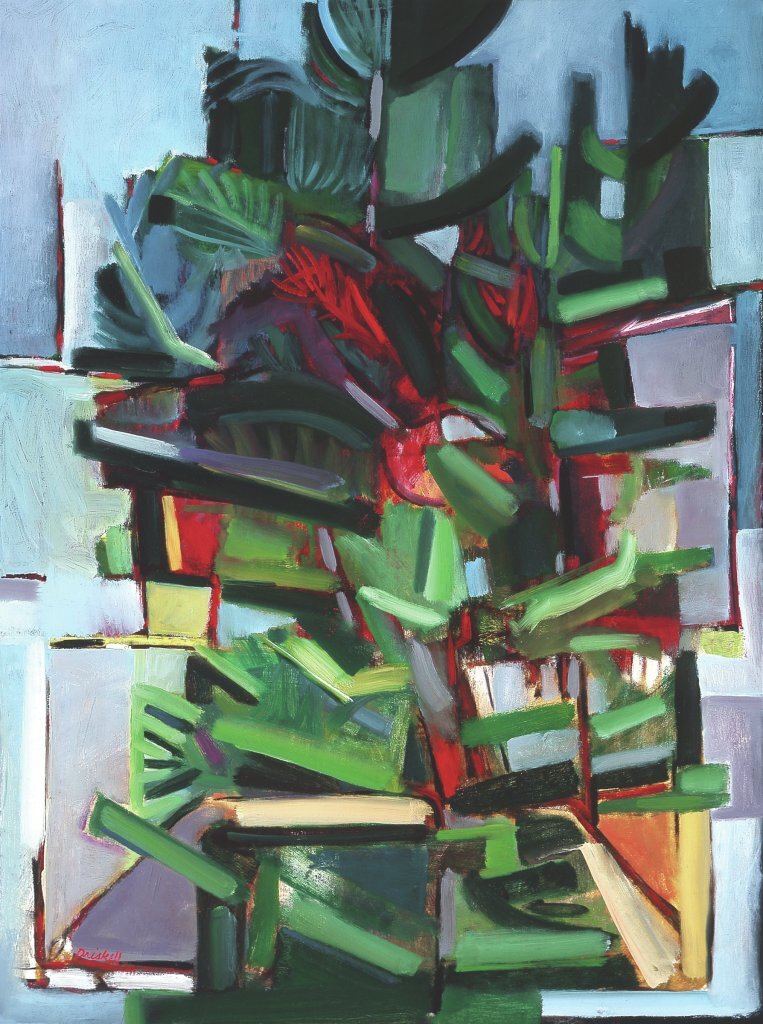
Some of those practice sketches stayed practice sketches. Others became a launching point for something larger. David C. Driskell’s work in the exhibition is an example of the latter. For nearly 45 years, Driskell drew pine trees, a fixation Pullagura traces back to a 1953 residency at Maine’s Skowhegan School of Painting and Sculpture and his master’s thesis. As Driskell put it: “I looked at trees with the notion of trying to see segments of them. I was trying to see into the center of the tree, around it, and up into its branches. … I wanted to take the viewer in all directions within the tree at one time.” His “Young Pines Growing” (1959), on loan from Clark Atlanta University, and the High’s own “Two Pines #2” (1964) hang side by side in the gallery, painted only a couple of years apart, one muted, one moving with color.
Studying memory and movements
During the tour, Pullagura shared that early drawing manuals were often the only way would-be artists received training. Formal instruction was neither accessible nor affordable to most — especially if you were not male. Pullagura pointed to correspondence courses built around manuals like Harding’s as an especially popular option. Tree studies, in particular, made good teaching material.
They also acted as process notes. Several sketches in the show carry artist annotation — shorthand reminders about color, light, or technique.
Works from the 19th-century American “etching revival” are on the wall, too. Robert Swain Gifford, who helped found the New York Etching Club, is joined by contemporaries Henry Farrer, Mary Nimmo Moran and Edith Loring Pierce Getchell, all etchers from that same late-1870s-to-1880s window.
Read More:
• Okefenokee Swamp clinches World Heritage status, officially joining ranks of top natural wonders
• 5 takeaways from Naomi Beckwith’s David C. Driskell Prize conversation
Beyond the paper
“Paper Trees” includes sculpture, too, even though it’s largely a works-on-paper exhibition. “It’s important for me to make sure that American art is experienced in every medium, because American artists work in every medium,” Pullagura explained. That range includes Bessie Harvey’s “Jacob Wrestling with the Angel” (ca. 1990), carved from found roots the artist believed held their own spirit, and Michelle Holzapfel’s “Restless Leaves Vase” (1988), turned from a cherry burl. Also on hand: wood samples from the Robert C. Williams Museum of Papermaking, meant to be touched, so visitors can feel the texture an artist was working to translate before it became a mark on paper.
Pullagura traces the curatorial approach on “Paper Trees” back to a question she said she asks of every exhibition she curates: What does American art mean? For “Paper Trees,” she narrowed the focus to how artists across periods and schools of practice thought about translating nature onto paper. She wanted to show, she said, “how that question evolves in such dramatically innovative ways.” Several works in the show have never been on public view before. “It was a great chance, selfishly also, to show areas that [aren’t] really seen,” Pullagura said.
“Paper Trees” is on view at the High Museum’s Works on Paper gallery through February 21, 2027.
