

Sandy Springs residents generally agree that the city needs more diverse housing options, but the community has different ideas for the missing middle’s location, density, and occupancy status.
During three Sandy Springs meetings Sept. 15-16, the city’s lead consultant developing “The Next Chapter” comprehensive plan shared community feedback on city planning goals with elected officials and citizen-led committees.
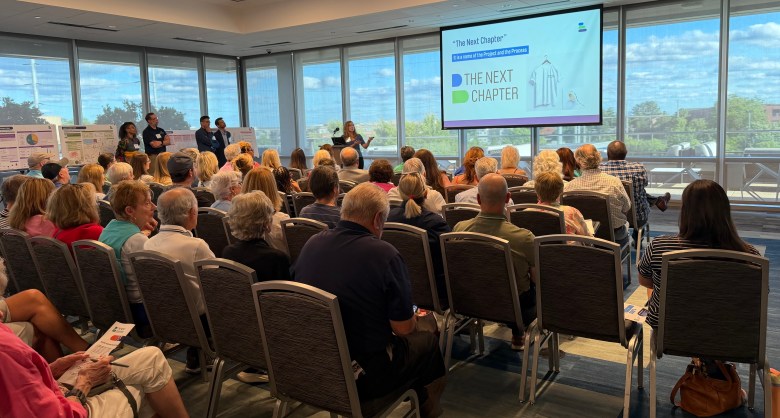
Ronda Smith, chair of the plan’s advisory committee and president of the Sandy Springs Council of Neighborhoods, said she has some lingering questions about city priorities regarding land use.
“The question is ‘the where’ of where [a greater range of single-unit residential housing types] happens in the future,” Smith said. “The policies will drive where that’s allowed.”
Housing and land use
The Next Chapter includes two parallel planning efforts: the state-required comprehensive plan and an update to the city’s parks plan. The advisory committee works with the consultant team to make discern resident feedback and draft policies.
While conducting a statistically valid survey, the team focused on four topics: enabling housing choice, enhancing walkability, preserving tree canopy, and increasing river access.
Some of those aspirations are at odds with one another, officials say. It’s hard to enhance walkability and expand housing choice while maintaining the city’s tree canopy.
“We do need some of our housing to be refreshed,” Smith said. “There’s there is housing that has outlived its functional life.”
Smith said she thinks the city’s development code, including lot sizes, setbacks, and frontages, is good to go. The city’s 2017 refresh of Fulton County zoning maps designates around 80% of the city as “protected neighborhoods,” preserved as areas with low-density, single-family homes.
“We have created some resistance to the development market as it relates to how infill and assemblages are handled within the neighborhoods,” Smith said. “You don’t do assemblages within neighborhoods anymore, like they used to.”
Limited affordability
The city’s zoning ordinances allow for some mixed-use residential developments, apartments, and townhomes, which have popped up in concentrated areas around the city since the last plan rewrite.
Smith said she thinks the addition of single-unit residential options in areas where commercial uses are already present is a great aspirational goal.
“Revitalizing underutilized office with huge expanses of asphalt, lots of parking lots; think of Powers Ferry,” Smith said. “Rather than see multifamily, it’d be great if we could see single-family there or townhouses, fee-simple, owner-occupied … there are tons of places.”
As housing affordability has become a nationwide problem, cities with high land costs like Sandy Springs are struggling to offer products to first-time homebuyers.
Because many municipalities have few single-family detached homes available below $750,000, many young families and first-time buyers are priced out, according to the National Association of Realtors. The average sale price of a detached home went from the mid-$600,000s in 2020 to about $975,000 in 2025. Only about 4-5% of for-sale volume is new construction.
Limitations of the plan
While the comprehensive plan affects planning commission and council decisions, the development code (or zoning ordinance) is legally binding.
Assistant City Manager Kristin Smith said Sandy Springs lacks strong guidance in its comprehensive plan on how to assess where infill development and subdivisions are appropriate.
“When a developer or property owner comes in and talks to us and says ‘I want to rezone these properties,’ like in the case of Spalding we had recently … that was ultimately approved,” Smith said. “We’re hearing non-stop across the community that folks want more choices. Right now, we have a lot of large lot single family, and I don’t think the nature of that is going to change.”
The approved rezoning allows the construction of 21 new single-family homes on what were five large residential lots along the Dunwoody border.

At August’s community meetings, residents generally agreed on improving housing diversity and adding missing middle options like townhomes and multiplexes, but not on their location.
There was equal resistance to dense multifamily apartments and large-lot, single-family detached “McMansions,” with a desire to preserve “naturally occurring affordable housing.”
The third of five public meetings for community members to give input on the plan’s policies and priorities is set for Oct. 29 at Sandy Springs City Hall from 6-8 p.m.
