
Bring your herd to The Secret World of Elephants exhibit at Fernbank Museum now through January 3, 2027 to learn the complexities behind how Earth’s largest animals evolved, communicate and help ecosystems thrive.

“When guests first enter the exhibit, many are presented with new information right way,” said Cara Martinez, Fernbank Museum school programs manager. “Most people are familiar with the African Savanna Elephant but not the African Forest Elephant, which is much smaller.”
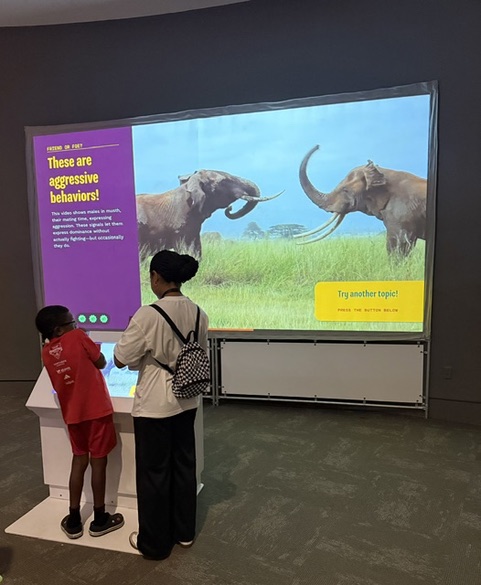
From there, life-sized models, replicas, hands-on interactives and immersive displays of modern elephants and their ancient relatives await as the exhibit flows from the species’ evolution; modern elephants’ body, mind, and socialization; their habitat and interaction with humans; and ongoing efforts to solve against threats. For instance, stare into the eyes of a life-size Woolly Mammoth or the much smaller Dwarf Elephant. Twist open a poop replica to see how elephant dung can support other life. Use a touch screen to answer if an elephant’s behavior with another is friendly or not.
“The elephant’s closest living modern relatives are always a surprise too,” Martinez said. Guests might suspect rhinos or hippos but manatees and furry rabbit-sized hyraxes are who bear the closest resemblance. Manatees have upper lips that act like a small trunk for pulling food into their mouths. Hyraxes have tusklike incisors and flattened, hooflike nails.
At every turn there are hands-on activities to enhance guests’ experiences. One of Martinez’s “must do” interactives is by the life-size Woolly Mammoth model.
“You touch the tusk model to track the Woolly Mammoth’s journey across what is now Alaska about 17,000 years ago,” Martinez said. Each layer of a tusk captures whatever the mammoth was eating at the time as well as information about its location and health.
“I like seeing how their range expanded as they got older,” a teenager told his grandfather who then shared. “I was born here in Anchorage, ” he said pointing to the map on the interactive. “But I didn’t realize the areas’ prehistoric history.”
And tusks aren’t just historic records; its ivory feature helps an elephant dig up roots, carve waterholes, push down trees and ward off predators. Sadly though, tusks are sought by the Ivory trade and threaten the iconic herbivore’s existence. Perhaps in defense, “female African elephants are starting to have smaller tusks,” Martinez explained. “This may be an adaptation which decreases the likelihood of being hunted.”
Next, Martinez advises guests to put your hand on the rumble pad near the life-size African elephant model and feel low-frequency vibrations. This is how an elephant can detect relatives as far away as 20 miles. Elephants also communicate by rumbles, trumpets, roars depending on the intended message – like deciding in which direction to move the herd to find a remembered watering hole.
Having the largest brain of land animals, elephants are also very self-aware and social animals, with herds led by a matriarch. To quiz your knowledge of elephant body language and socializations, try the large-screen interactive behind the African elephant model.
A first grader who just started reading, stepped up to the interactive to try his luck, “He is very curious,” his Mom said. “He was right on the two questions!” It’s a first visit he’ll never forget.

As the exhibit explores elephant habitat, it highlights their role as a keystone species. “Elephants hold their ecosystem together,” Martinez explained. “Without elephants to create the paths in the forest other animals couldn’t move through without being seen. Without elephants being seed dispersers – eating seeds and pooping them out later – we wouldn’t have the forest they live in or as many watering holes in the savanna.”
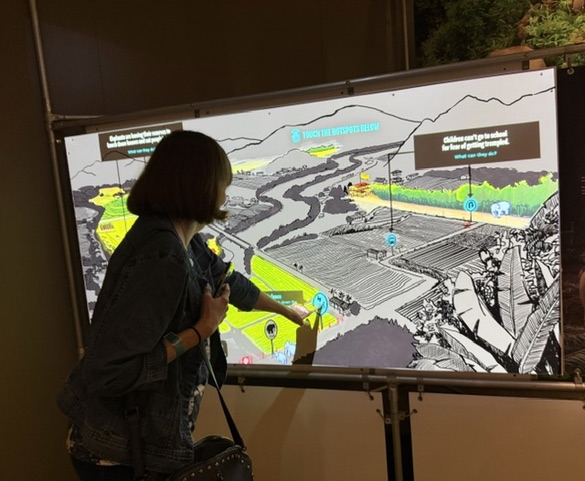
Guests can also investigate elephant and human co-existence in places like Myanmar, where elephants sometimes damage crops or cause students to miss school. See another giant screen interactive that explores some of these problems and possible solutions, like creating elephant paths through farmland.
“The exhibit ends with a proactive call to protect elephants, through mutually beneficial practices like ecotourism,” Martinez said. “And through other practices like ongoing learning, voting, and supporting conservation efforts and vetted charities.”
The Secret World of Elephants is sponsored locally by the Isdell Family Foundation with support from Frances Wood Wilson Foundation, [organized by the American Museum of Natural History, NY.]
Plan your next visit here! Those 21+ can check out the exhibit at Fernbank After Dark on November 13, 2026. For more information, visit FernbankMuseum.org.
