

By Kimberly Brigance, Clarke Otten and Michael Hitt
Before there was a Sandy Springs, the streams, ridges and forests of our community were home to Native Americans. For more than 10,000 years this land was their home. Evidence of Archaic (8,000 BC – 1,000 BC) and Woodland (1,000 BC – 900 AD) presences have been found in dozens of rock shelters and other documented sites throughout Sandy Springs.
Three of the largest and latest groups to live here were the chiefdoms of the Mississippian era (900 AD – 1540 AD), the tribes of the Creek Confederacy and the Cherokees. Although their story is incomplete — in part because they left no written history and in part because of the destructive forces of time — it is an important part of the history and identity of Sandy Springs.
More than 1,000 years ago, the first great farmers of the region cultivated corn, beans, squash, sunflowers, tobacco and gourds. Chieftains commanded large armies and artists created beautiful works from shell, stone and clay. They also created storehouses to sustain the population through difficult times.
With a stable supply of food, large towns began to develop along fertile river bottoms. Some of the towns may have had as many as 25,000 inhabitants. Towns were centered around large man-made earthen mounds used for ceremonial purposes. Etowah Mounds near Cartersville, the Ocmulgee Mounds near Macon and the Kolomoki Mounds in southwest Georgia are all prime examples of this advanced period of civilization.
No mounds are known to have existed in Sandy Springs. The closest would have been the small mounds at the village of Standing Peachtree near the confluence of Peachtree Creek and the Chattahoochee River. Two mounds were recorded as being near there, but sadly little archaeological research was done there before they were destroyed. The next closest mounds are the Nacoochee mounds south of Helen.
Despite the lack of mounds, the land around Sandy Springs is marked prominently with other evidence of the Mississippian life, such as rock fishing weirs.
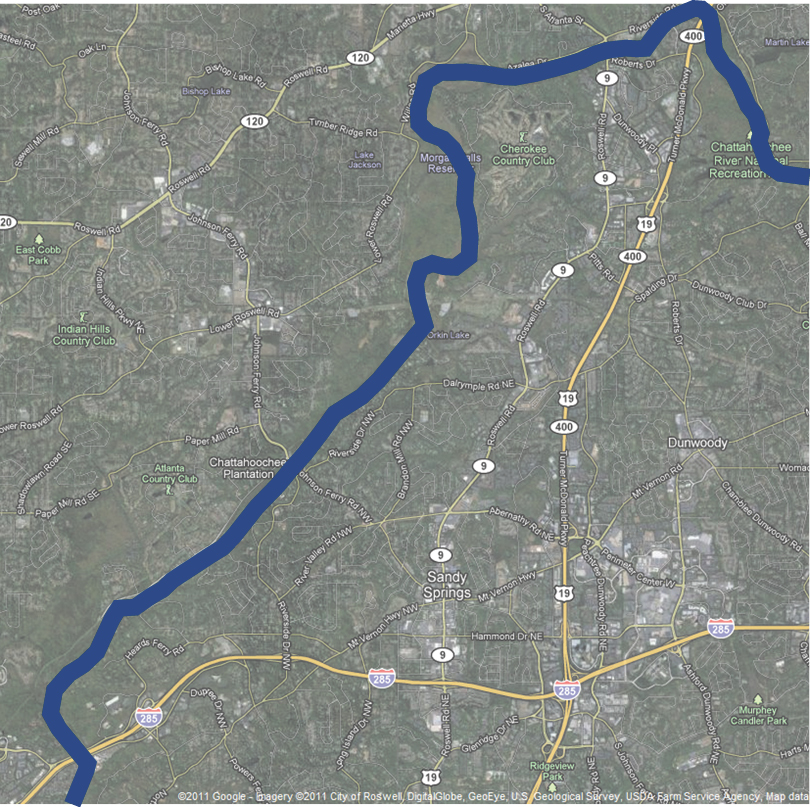
Rock dams were built across shallow points of rivers and streams, usually in a “V” or “W” shape. Fish were herded downstream and caught in the funnel created by the weir. Large amounts of fish could be caught in a short time, suggesting that perhaps a substantial population once lived near the river. The remains of three such weirs cross the Chattahoochee between Cobb County and Sandy Springs and are likely the oldest Native American cultural resources we have left in our city.
Although not acknowledged with historic markers or celebrated as the cultural treasures they are, the weirs are still visible today. They are best seen from the air during periods of low water.
They are located, from south to north, as follows: one V-shaped weir just south of Cochran Shoals, but north of I-285; a W-shaped one north of where Sopes and Heards creeks enter the river and south of the Johnson Ferry Bridge; and a V-shaped weir between the Johnson Ferry Bridge and the Morgan Falls Dam.
As advanced and powerful as the Mississippian chiefdoms were, they could not withstand the onslaught of European diseases. Unknowingly, the founding of Spanish missions along the Georgia coast and contact with European explorers in the early 1500s signaled the end of their way of life. Some researchers estimate that by the early 1600s, 80 to 90 percent of the native population had succumbed to disease.
In Sandy Springs, the fish weirs of the Chattahoochee remain a silent and almost forgotten legacy of the Mississippian people and of our community’s Native American heritage.
Kimberly Brigance is the curator of the Heritage Sandy Springs Museum, 6075 Sandy Springs Circle. This article is based, in part, on materials from the museum’s collection. To contact her, e-mail kbrigance@heritagesandysprings.org.
Clarke Otten, a resident of Sandy Springs since 1953, is writing a book on the history of Sandy Springs.
Michael Hitt, a Roswell police officer, serves as historian for the Roswell Preservation Commission and has published several local history books and articles.