

In DeKalb County, planning for Stone Mountain Trail crosswalk art isn’t happening in a design studio alone. People who use the trail every day are shaping what’s to come, too.
Through the Connecting Communities Stone Mountain Trail Project, Georgia State University students are using an approach called participatory design, working with area residents to co-design crosswalks and trail markings along a five-mile stretch from the Avondale Estates MARTA station to Clarkston.

Fernando Rochaix)
Connecting Communities projects that the crosswalks could cut vehicle speeds by up to 20% and increase trail use by 30% within the first year.
How did the Stone Mountain Trail project begin?
Several years ago, the city of Clarkston contacted the Department of Fine Arts at Georgia State’s Perimeter College about partnering on public artwork. In April 2023, Perimeter College art students spent a day painting a crosswalk mural at Market and Vaughan streets in downtown Clarkston. Designs drew in part on feedback from the community. A Georgia Municipal Association placemaking grant paid for the project, as part of that year’s Georgia Cities Week celebrations. Two murals followed.
As word of that work spread, DeKalb County Commissioner Ted Terry, a former Clarkston mayor, approached Fernando Rochaix, an associate professor of art history at Georgia State and the university’s Connecting Communities lead, with an idea: look at the Stone Mountain Trail and propose a way to bring public art to it. Rochaix’s first pitch imagined an artistic corridor with sculpture, interactive art and crosswalk paintings. Terry steered the project toward art on the pavement itself, along that five-mile stretch.
Funded by DeKalb County, Connecting Communities now calls for crosswalks and trail markings at 26 locations, including 15 major intersections. The goals include more trail use, slower traffic at busy intersections and new business for the area.
What does Georgia State bring to the project?
Perimeter College has been part of Georgia State since 2016, when the university consolidated with what was then Georgia Perimeter College. Many students start there before transferring to Georgia State’s Atlanta campus for a bachelor’s degree.
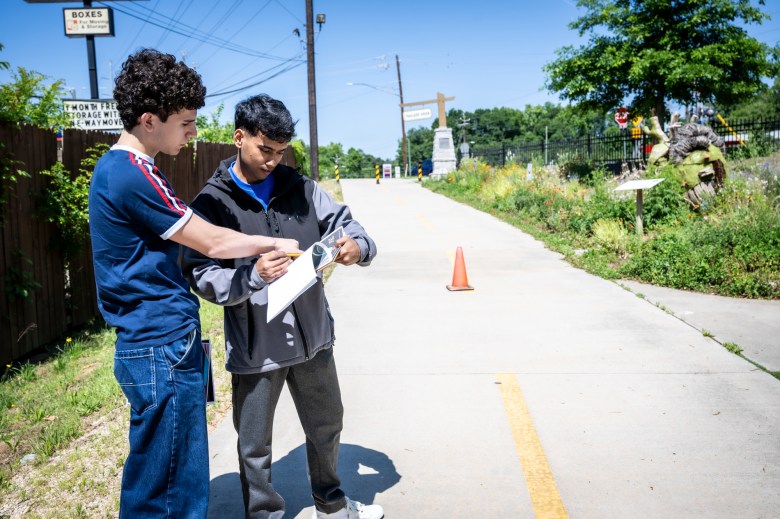
The six undergraduates on the design team took that path. Each earned an associate degree at Perimeter and now attends the Atlanta campus, studying computer science or art and design. The students are paid for their work, which includes running participatory design workshops with residents, business owners, faith leaders and youth; building AI models for the design process; designing the project website; and handling outreach, public relations and social media.
What does participatory design mean?
Instead of hiring one artist or design firm, participatory design brings the people affected into the design process, Rochaix said. The approach dates back decades to Sweden, where designers asked workers what they needed and built around how they worked, Rochaix said. The team applies the same thinking to the trail. Residents might not be trained designers, but they know the trail and the neighborhood. “They use the trail every day,” Rochaix said.

In practice, that means listening sessions, youth workshops and digital surveys in more than 10 languages, asking neighbors what makes their part of the trail feel like home. Residents will also vote on the final designs.
More than 60 people have completed the team’s design survey so far, Rochaix said. It asks residents to share stories, ideas and safety concerns. The team also held three open house design sessions and took the project to Compassion Con, Compassionate Atlanta’s annual festival and community-building conference, in October.
The team uses AI to help residents see their ideas. Computer science students built two AI models that turn residents’ input into quick visual mock-ups, according to Rochaix and the university. Instead of commercial products, the team runs open-source models on its own equipment, which the university says protects privacy and uses less energy. “We’re trying to do AI for good, not for evil,” Rochaix said.
And. residents can still weigh in. The survey is open online at the Connecting Communities website and takes about five to seven minutes.
Read More:
• $4.6M grant to help GSU students earn bachelor’s degrees
• Discover Decatur’s natural beauty: A guide to the best walking trails
What’s next for the project?
Connecting Communities wraps up its design phase in December. The team will deliver a report with the proposed designs to DeKalb County and then select a vendor to paint them, Rochaix said. He also plans to write a paper on the design process with some of the students.
Rochaix doesn’t expect all sites to be ready for another year, though he said some painting could come sooner.
For him, the measure of success is how the communities impacted feel in the end.
“This project should uplift the community in a meaningful way where the community has a direct sense of ownership over what they’ve contributed in this process,” Rochaix said.
