

Sandy Springs residents lined up at City Hall on Nov. 9 to get a glimpse of how proposed changes to flood maps could affect their properties.
For homeowners, the changes could determine whether they must buy flood insurance or could determine whether residents can make additions to their homes by placing their homes in areas identified as at a high risk of flooding.
Greg Anderson and Mary Mattson came to the meeting after receiving a notification about changes possibly affecting their home on the Chattahoochee River, which stands 50 feet above the river level. They said the meeting put their minds at ease.
“The issue is, with so much pressure on the real estate market, people might view an extra $200 [for flood insurance] as something they can’t do,” Anderson said.
Sandy Springs held the first of its two planned public meetings to review the changes, and invited residents to meet representatives of the city, the Georgia Department of Natural Resources and Federal Emergency Management Agents. The next meeting will be held Dec. 7.
Collis Brown, program manager for the Georgia Department of Natural Resources, said new studies have reevaluated the flood mapping of the upper Chattahoochee River basin.
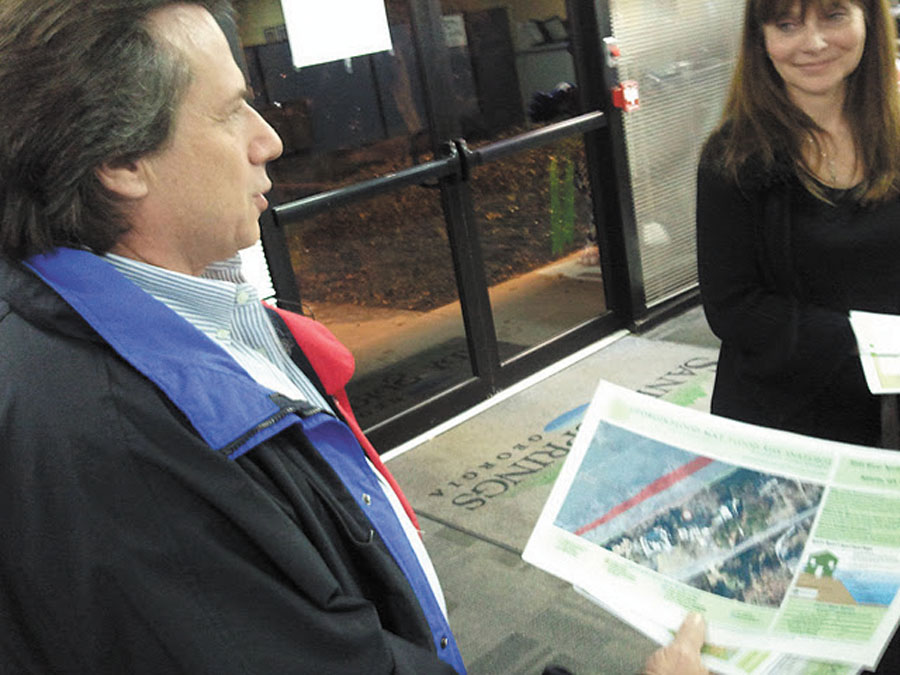
“We have prepared preliminary maps and local governments are reviewing them and we’ve met with them,” Brown said. “Some of them have chosen to hold public open houses.”
Brown said in December a 90-day public appeal period will begin during which the public can challenge the existing maps. If someone disagrees with the maps, he or she will have to provide their own data to dispute the claim, he said.
He said if the Sandy Springs City Council rejects the new maps within six months after the review period, the city will be removed from the federal National Flood Insurance Program. If that happened, he said, residents with flood insurance policies would be unable to renew them.
The new maps will go into effect in November 2012, Brown said.
Tom Shillock, a geographic information system specialist for Georgia DNR, said the current maps are more advanced than they were a few years ago.
“It’s a far more accurate level of detail,” he said.
Bill Hooper, whose Sandy Springs home is on Riverside Drive near the river, said his new flood map status potentially creates a problem for future financing of his home.
“The advice given to me was to recruit an engineer and start the process for applying for a letter of map change,” he said.
A “letter of map change” allows properties that are on naturally high ground in a flood area to be exempted from the federal flood insurance requirement. Hooper said it seemed an overly-complicated way of doing something fairly straightforward.
“It gave me a starting point,” he said of the meeting. “It will clearly state improvements are out of the flood zone, even though the land is in the flood zone.”
